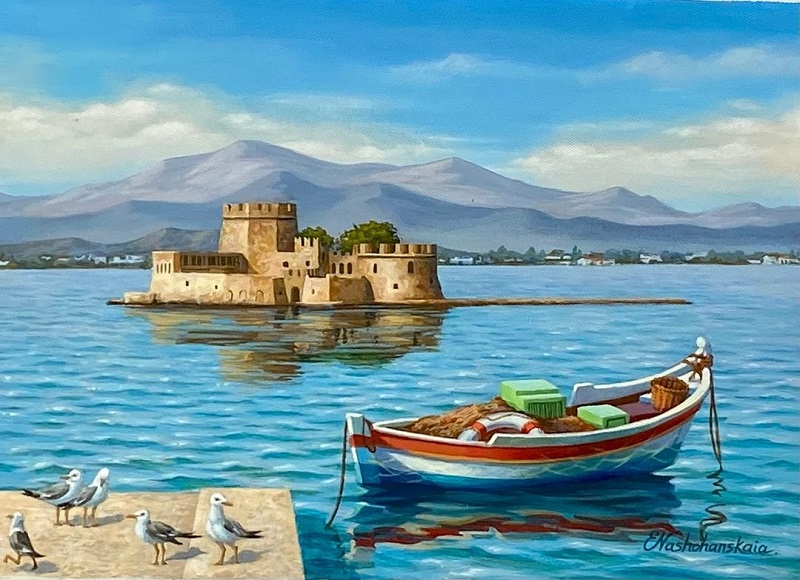
Nafplio
Nafplio is a city in the eastern Peloponnese
It is the seat of the municipality of Nafplio, the capital of the Regional Unit of Argolis and one of the main ports of the eastern Peloponnese. According to the 2021 census it had 14,532 inhabitants. The historic center of the city has been characterized as a traditional settlement, while it was the capital of Greece during the period 1827 - 1834.
The city is built on the south-eastern edge of the fertile Argolic plain, on the Argolic gulf and is known for its very well-preserved old town which attracts a large number of visitors all year round, its agricultural production consisting mainly of citrus fruits (oranges, tangerines, etc.) .a.) and its port which attracts a significant number of pleasure boats, but also commercial ships.. It also houses a large number of public services and the Department of Theatre Studies of the University of the Peloponnese.
According to Greek mythology, Nafplios founded Nafplia on the site of the present-day city, which was fortified with cyclopean walls. Archaeological findings prove the existence of the city since the Mycenaean times. However, the city lived largely in the shadow of Mycenae and later Argos, being of minor importance. The city began to develop during the early Byzantine years, when refugees from the interior of the Peloponnese settled on the fortified hill of Acronafplia.
However, the real development of the city will come with its concession to the Franks in 1212 and mainly after 1388 when it was occupied by the Venetians. The Venetians took care of the expansion of the city, its fortifications and its port, making it one of the most important cities in the Peloponnese. In 1540 the city was occupied by the Ottomans until 1686, when the Venetians recaptured it. The second period of Venetian rule is characterized by the creation of the powerful fortress of Palamidi and by significant building activity. In 1715 it was again incorporated into the Ottoman Empire and was even designated the capital of the Vilayet of the Morea until 1770, remaining an important local center.
The city played an important role in the Greek Revolution, with a prolonged siege beginning in 1821 and ending in 1823. After its liberation, it was designated the capital of the country until 1834, when Athens was declared the capital of Greece. Nafplio was designated the seat of the province of Nafplio and the prefecture of Argolidocorinthia (later the prefecture of Argolida) and followed the course of free Greece.. The importance of the city would decline significantly with the emergence of new trade routes and the development of the ports of Corinth, Gytheio and Piraeus, but it would remain one of the most important cities in the Peloponnese.


