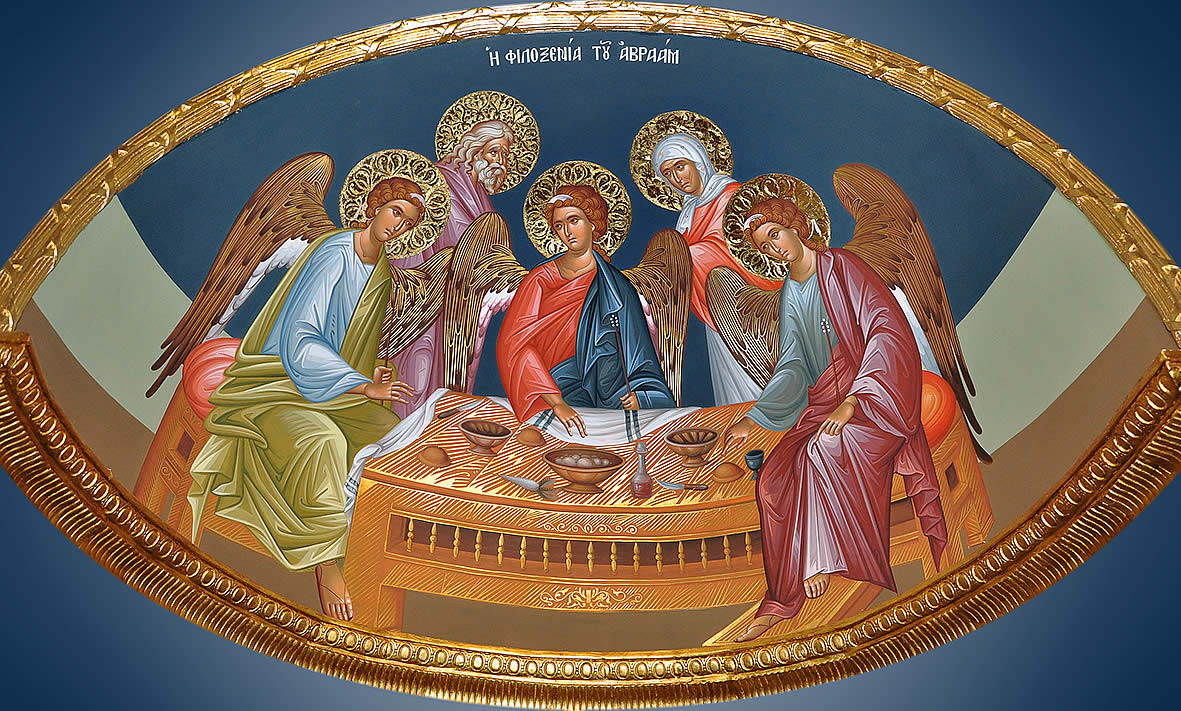
Hagiography
Hagiography is the art of depicting holy persons or religious scenes; it is the pictorial representation of religious subjects. The hagiographies draw their subjects from life and especially the miracles of the men and women canonized by the Church. Hagiography is central to the Orthodox tradition and less so to Western Christian traditions such as Roman Catholic and Anglican.
According to the Orthodox tradition, the hagiographic image does not aim at a realistic representation of a person but has primarily a spiritual semiology since through it a life relationship with God and His Saints can be achieved. The image creates a sense of living presence and brings the believer into a personal relationship and contact with the being of the person depicted.. Hagiography is therefore not considered as a simple work of art or a religious painting but is a means by which man can reach holiness.
It is important to mention that the worship of the image "passes" through the visible image in the original, i.e. to the truly existing holy person who is depicted.
Ecclesiastical tradition states that the first icon, in the sense of representation, was made by Christ himself, and even without hands. The story of this image in brief is as follows: Aygarus, king in Edessa in Mesopotamia, suffered from leprosy. So he wrote a letter to the Lord, begging him to go to Edessa to heal him.Την επιστολή μετέφερε στην Παλαιστίνη ο υπηρέτης του Ανανίας. He also tried to paint the Lord without succeeding. The Lord who perceived the effort of Ananias, asked for water to be married and wiped His face with a handkerchief. The divine form of the Lord was miraculously captured and the handkerchief in question is known as the Holy Handkerchief. Even tradition mentions the Evangelist Luke as the first iconographer. The Evangelist first painted three images (of wax, mastic and paint) of the Blessed Virgin Mary carrying the Lord Jesus Christ in her arms. He then offered them to her wanting to know if she liked them. The Mother of the Lord received them with love and said: "The grace of him who was made of me be with them through me.". Of these three holy icons, one is located in the Peloponnese in the Holy Monastery of Megalo Spileio, the second in Russia and the third icon is located in Cyprus in the Holy Monastery of Kykkos. Also, according to tradition, the Evangelist Luke also painted the icons of the Holy Apostles.


